Artist's Statement (as of April 23, 2003)
(This is old and out of date. I posted it here for archival purposes only.)
I. Creative philosophy
To what level can we reduce the visual strength of a signifier and have it retain its signifying ability? Immediately below this hypothetical level, will the signifier disappear into obscurity, or will it inherit a unique value due to this newfound freedom from having to signify? This ultimately depends on the perception of the viewer. Some will inevitably treat the forms I create with the same visual interpretation techniques they apply when they see animals in the clouds - no animals reside in the sky in such a fashion; rather a shape is stimulating the viewer to imagine such a form. Others will dismiss the work as confusing. No matter what the viewer does to my work, I intend to limit the use of signifiers to such a degree that the overall image loses all conventional representations of common forms, but displays images distinct enough to give the overall image a unique value.
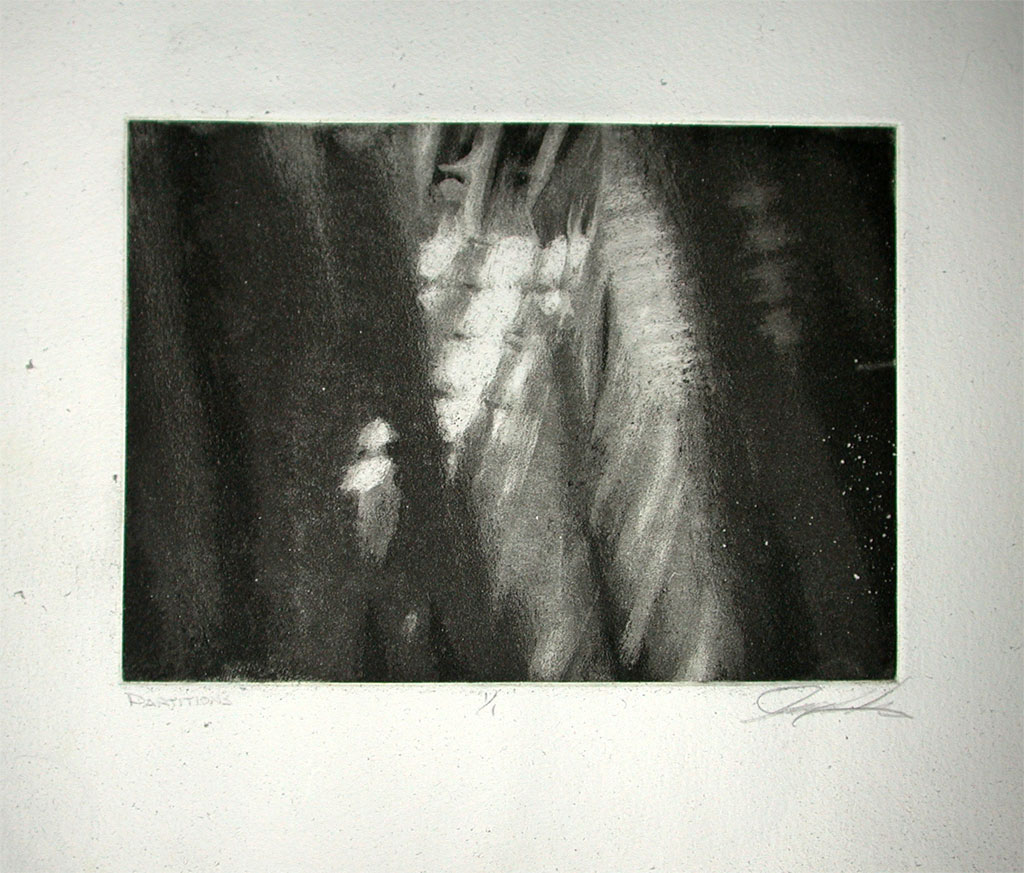
figure 1 - Partitions (2001)
If a recognizable form is used as a point of departure, the many methods for weakening the signifier include subtractive processes: cropping, blurring, simplifying, or the additive process of combination, such that the representation of multiple objects invokes visual confusion. For Partitions (fig 1), an intaglio print created in spring 2001, the image is based on a close-up photograph of a computer heat sink in front of a window screen. This is an illustration of a few basic abstraction techniques: cropping, in that the full form of the objects are not revealed, and combination, where the similar values of the front and back of the heat sink overlap with those of the screen. The total image is not entirely of the heat sink, and also not entirely of the screen. So what is represented? The objects have the potential to 'disappear' due to cropping, but after a brief description of the objects represented in the image, the viewer imagines the objects in place and their essence returns to the image. This essence signifies the presence of the two objects, and the illusion that they disappear is broken.
Since the power of a signifier depends on the viewer's perception, one can exploit the weak signifying power of an existing unfamiliar object. Hoochit (2002) (fig 2) is mostly void of recognizable character aside from its somewhat tree-like, vertical undulating surface. It could have been based on almost anything, but it comes from a photographic study of molten marshmallows (figs 3 & 4). The destructive power of describing Partitions occurs once again when the original photograph and corresponding sketch are presented next to Hoochit. The illusion again dies, and the painting regains its signifying power.
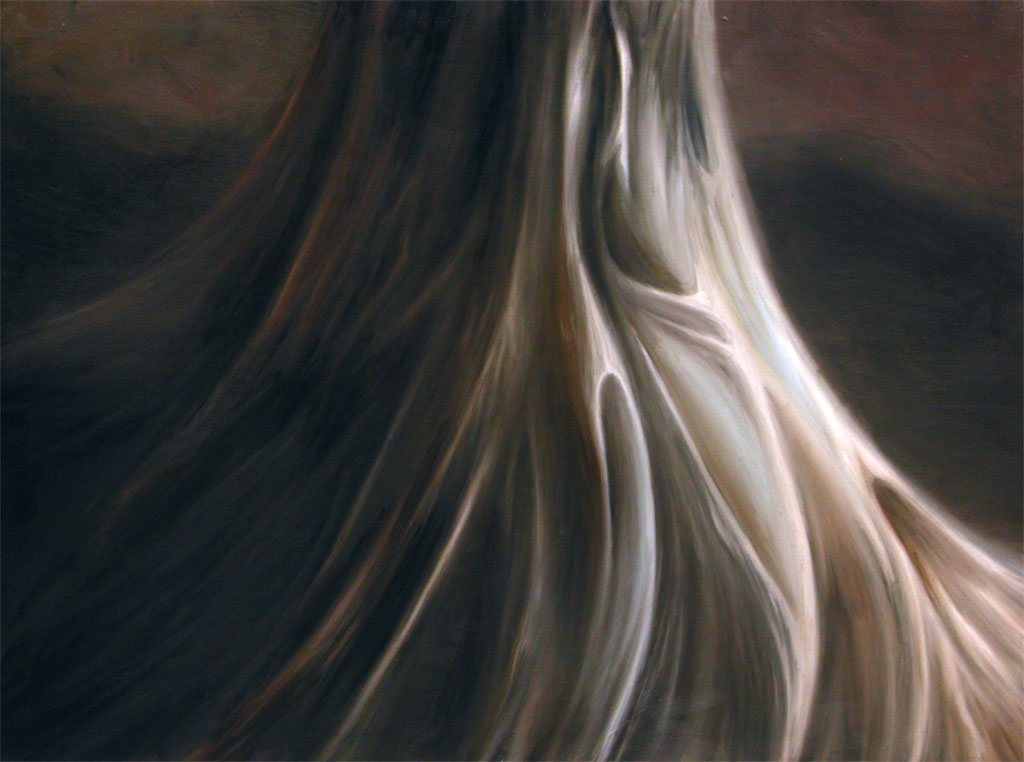
figure 2 - Hoochit (2002)
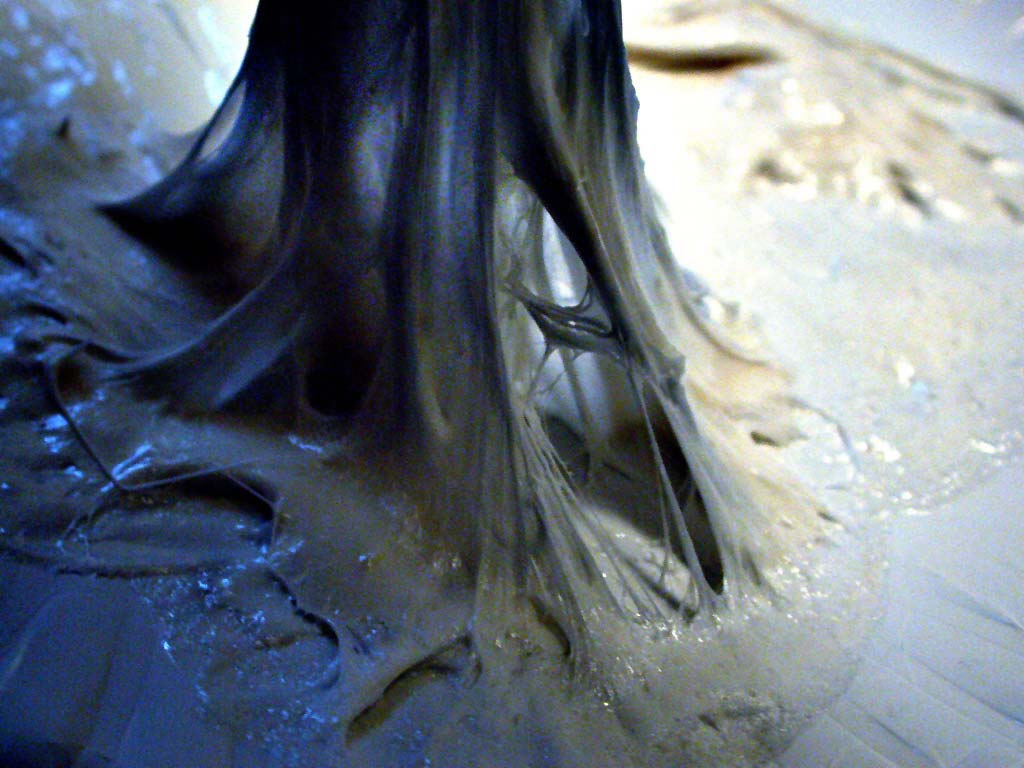
figure 3 - molten marshmallows
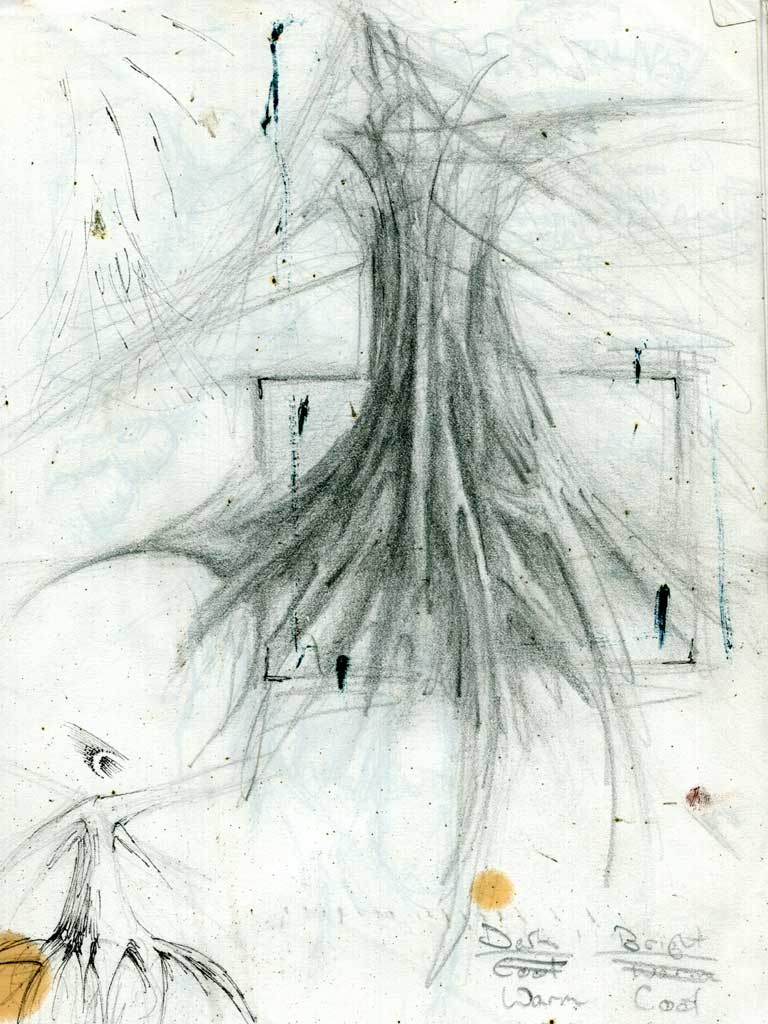
figure 4 - 'marshmallow tree'
A more successful image however may be created by not appropriating a recognizable form. With W.T.F. (2002) (fig 5) and Somethingsomething (2002) (fig 6), highly developed scribbles suffice. The only signifiers are surfaces containing simple lighting effects. The title of W.T.F. guides the viewer's interpretation, but the easily understandable un-abbreviated form, "what the f***?" provides no concrete answers. The frustration implied in the question is comparable to the viewer's unfulfilled state of curiosity upon attempting to decipher the work. Likewise, the surfaces in Somethingsomething do not coalesce into complex forms, for the likes of which would more certainly conjure up an image of a familiar object in a viewer's mind and therefore relegate the work to being a symbol for that object. If anything, it is a cropped image of a non-existent object. Since W.T.F. features a vertical fluted form, a cube, and a horizon containing other cube-like structures, it is therefore less successful than Somethingsomething at being truly non-representational. W.T.F. is however more successful at creating dissonance between being representational and being abstract.
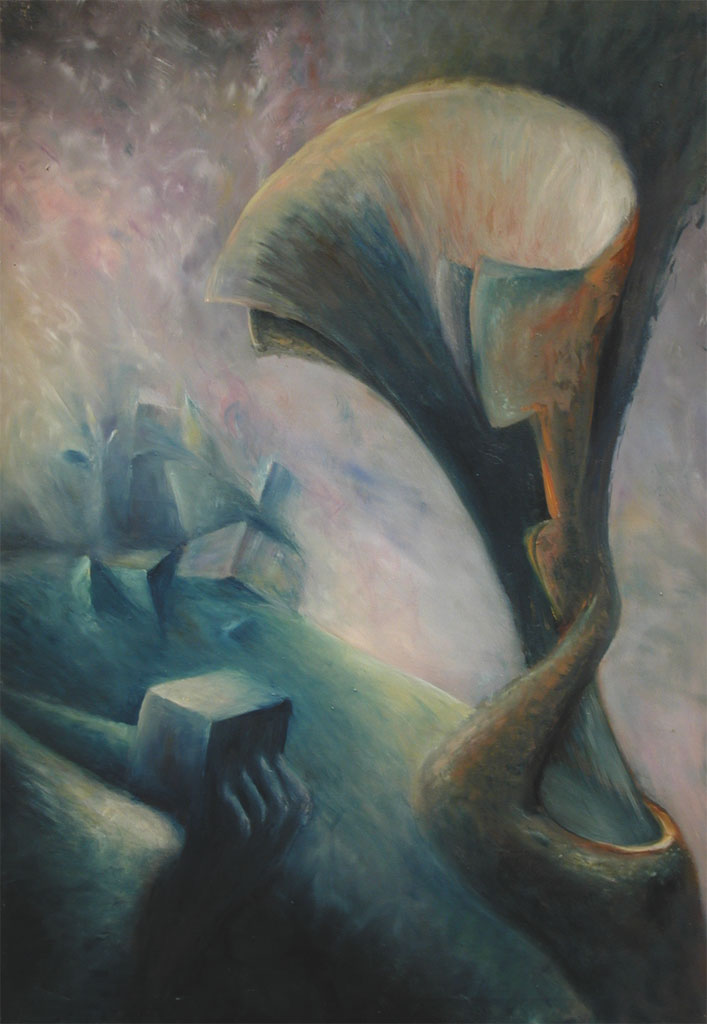
figure 5 - W.T.F. (2002)

figure 6 - Somethingsomething (2002)
This type of success in W.T.F. potentially reveals a visual schizophrenia in my work. In the context of Worringer's Abstraction and Empathy, my work is performing the illogical by following opposing creative paths - the abstraction impulse, and the imitation impulse<1>. On one hand, my work seeks value in barely representing anything, but on another it is still embracing the non-contemporary idea of representing a realistic scene. The most successful of such 'imitative' scenes is Lament For A Stolen Work (2003) (fig 7). It communicates my feelings for losing a painting to theft with a stylized representation of the room in which it was stolen, and fingers reaching into the space representing the desire involved (either that of the thief's desire for my painting or my own desire to get it back). To visually connect it to the stolen work itself (fig 8), a few non-representational forms appear along the left half of the image.

figure 7 - Lament For A Stolen Work (2003)

figure 8 - untitled (2002), stolen.
No matter how 'non-representational' the forms become, whether in Lament, W.T.F. or Somethingsomething, they still imply a realistic space. The structural elements along the left side of Lament and the fluted form of W.T.F. employ chiaroscuro lighting, the curved tunnel from Somethingsomething appears to extend around a larger curved surface and back into space, and the surface from Hoochit appears to undulate and flow as if it were a mixture of cloth and hair.
This schizophrenia can be explored by examining my influences. According to Maurice Merleau-Ponty, "any knowledge of man by man is not a mere external study but rather a personal re-living of what the other has experienced or still experiences."<2> When studying one's output, this theory should easily apply. Essentially, as random as it appears, my most successful attempt at being non-representational - the scribble - is not totally random. Albeit indirectly, it is influenced by a combination of past and current conditions: the sum of all past knowledge, current surroundings at the time pen meets paper, the oxygen content of the room, and even biological limitations affecting fine motor control. Thus the gesture still retains the power to signify. Only by understanding that through indirect influence, my non-representational works begin to coincide with my imitative works and the schizophrenia subsides.
As proof that past influences affect my work, and due to a relative lack of experience with non-representational painters, the music of Autechre influences my work more than any visual artist.
This British duo creates electronic music that presents the
attributes of the digital equipment itself rather than using it as a tool to
create conventional music. Many tracks from their first few albums used 4/4
timing, samples from traditional (non-digital) musical instruments, repetitive
measures, and followed a chorus-verse structure. As their career progressed
however, their work dropped its reliance on comfortably discernible patterns,
melodies, and recognizable instruments, and began focusing on digitally
enhanced, and somewhat abstracted digital noise. Through intensely micro
programmed musical patterns, their seventh album, aptly titled EP7 (1999)
brought the nature of the medium itself to the foreground. In a review of EP7,
Village Voice critic Eric Weisbard said of Autechre, "Instead of transcendence,
[they] strive for viability. Like the framers of the Constitution, they dream
about a machine that would go of itself".<3> In other words, they intend for their
non-representational, instrumental work to stand on its own without reference to
anything external. Due to their complex use of effects, the sounds produced by Autechre lose most of their ability to signify, yet seem to be just as musically
viable as a clearly discernible piano note.
II. Painting - an old medium in a new era
Painting is visual communication. Even the word "viewer" implies that there is someone "viewing". How can the blind experience a painting? They can touch it and explore the texture developed by the application of paint, or feel the wooden solidity of the stretcher frame, but beyond the blue-collar physical attributes of the work, the blind cannot receive much information from paintings. They perceive them as rectangular sculptures where most works seem identical. Despite it being such an unfortunate disability, it illustrates the strength of painting's two-dimensional nature.

figure 9 - untitled (2003)
My interest in displaying three-dimensional forms on this two-dimensional surface illustrates a bit of confusion, and possibly another element of schizophrenia - why am I not creating three-dimensional forms in three-dimensional space? Again, I do not consider this a problem. Since the 1950s, popular methods for experiencing such two-dimensional work were in a movie theater or at home in front of a television. With the advent of digital media, the population at large is becoming accustomed to viewing the world as two-dimensional media on a computer or television screen. The use of a canvas with a 16x9 aspect ratio for untitled (2003) (fig 9) is not only an homage to the film experience, but also a way to attract attention to my work. Viewers might not verbalize it, but they should make an unconscious connection with the aspect ratio, "that looks like a movie screen, this should be interesting". It is simply a hook.
The cinematic experience demands the viewer to willfully suspend disbelief and mentally engage the images as if they were enveloped in the space and events depicted onscreen. In other words, the viewer is 'pulled into' the film. Andre Bazin mentions the idea that filmmakers are interested in recreating reality and had that desire long before all the elements for contemporary cinema were put in place: "Seeing people immobile in space, the photographers [of the nineteenth century] realized that what they needed was movement if their photographs were to become a picture of life and a faithful copy of nature."<4> The viewer is aware that he is experiencing a film (physically in front of the screen, and mentally engrossed in the film) and is therefore aware of being in two places at once. The implication that cinema alters the current reality makes it a second-order simulation according to Baudrillard's Simulation and Simulacra.<5>
Despite the relatively new nature of computer technology in relation to television and movie screens, it is simply a perpetuation of having two-dimensional imagery represent that of the third dimension by borrowing the viewer's willful suspension of disbelief.
"For centuries, artists have tried to capture the effects of light to present an image just as the eye sees it; Monet meticulously painted every spot of sunlight on the London's Parliament building at different times of the day. Today's game developers struggle with the same thing. 'It's about creating a suspension of disbelief, and the thing that lets you do that is lighting,' says Andy Thompson, director of advanced technology marketing for ATI Technologies, the Ontario-based company that manufactures Radeon graphics cards. 'Lighting is critical to making people think a game is real.'"<6>
Video games take cinema's simulation of reality one step further by adding a layer of interaction. By stepping in as a new reality, games then become closer to being a full-blown, fourth-order simulacra - a hyperreal.<7> Of all computer-based entertainment, those with a first-person perspective are some of the most convincing due to their all-encompassing nature. The player/viewer does not control a visual avatar on the screen, and therefore his current physical form takes the place of the unseen avatar. These games have taken upon such a convincing nature that the U.S. military has begun using them as training tools (as in Orson Scott Card's book Ender's Game): Taken from a New York Times article:
"'You can get so habituated to the gamed reality that the real reality, what's on the ground now, is thought to be artificial,' said James Der Derian, principal investigator of the Information Technology War and Peace Project, a nonprofit group that studies the impact of technology on global politics. 'If the war doesn't go according to the game, you just keep trying to make it fit.' . . . . 'Anything but war is simulation,' says Ralph Chatham, the co-author of a recent Defense Science Board report on training that recommended the adoption of virtual technology. (Mr. Chatham attributes the quote to a retired general, Paul Gorman). 'Virtual games won't teach you how to walk through thick grass, but they will teach you what to think about when you walk through thick grass, and you'll be a lot better off when you get to that grass.'"<8>
Essentially, the simulation affects the player/viewer on an emotional, ephemeral level, not on a physical, technical level.
Psychologists at the Army Research Institute are monitoring the game's use and tracking a control group that is not using the game to try to measure its effectiveness, but Major Cummings said the buzz in his classroom made him believe that people were learning. "They're immersed into the game," he said. "You don't command a company with a keyboard and a mouse, but somehow the guy thinks he's in there. When that happens, he's experiencing this different level of learning."<9>
Supposed 'all-encompassing' games cannot achieve the full status of a fourth-level simulacra due to their interest in mimicking current reality. Since painting is an analog medium, it is not restricted by the seemingly artificial limitations affecting the digital realm - it is not divided up into pixels on a screen, it does not have a limited resolution, a restricted frame rate, or a social expectation to cover a narrative. The nature of the painting surface allows the artist enough freedom to perform a near infinite number of things to the image - it can be of whatever size, can contain fine or coarse detail.
With such freedom, I am experimenting with more intense abstraction, more complicated objects, more dynamic use of gesture and surface effects, strictly non-representational painterly techniques, and the occasional bit of subject matter. With a limited application of recognizable imagery, my work is seeking value by differentiating itself from the familiar. The world does not need to be copied or simulated, for the nature of a copy decreases the inherent value of the original, and the presence of the original leaves the copy with a less valuable existence. With enough abstraction, and allowing for indirect influence, my work may eventually imitate a machine that will go of itself.
citations
- Wilhelm Worringer, Abstraction and Empathy (New York: International Universities, 1953), 21.
- Remy C Kwant, The Phenomenological Philosophy of Merleau-Ponty (Pittsburgh: Duquesne University, 1963), 114.
- Eric Weisbard, "Beat and Variation," The Village Voice 32 (17 August 1999): 120-123.
- Andre Bazin. "Myth of Total Cinema" in What is Cinema, (University of California Press: 1967), 22.
- Jean Baudrilllard. "Simulation and Simulacra".
- David Kushner, "Prepare to Meet Thy Doom," Wired 5 (May 2003)
- Baudrillard, (cited n. 5).
- Amy Harmon, "More Than Just A Game, But How Close To Reality?" New York Times, (3 April 2003), sec G, 1.
- Ibid.
(c) 1998-Today. Jason Wallace.